Friday, April 1, 2011

Styrofoams


Styrofoam s

I love printmaking even though my actual printmaking career was quite short-----about three years. But I still love the process of creating images making impressions and layering lines and colors. I was conducting an after school program with 3rd and 4th grade students who had never knowingly created any kind of print until I asked them if they had ever walked in mud or snow and looked at the impression that their shoes had left behind. Oh yeah, foot prints. The art work that I wanted to create with them was not so different than what the feet left behind.

Because the surface on which the prints were to be made was identical to the trays that are used to package chicken and some vegetables in grocery stores, I called them Styrofoams. The students sketched drawings that were then retraced onto the Styrofoam leaving lines that were etched inot the Styrofoam, which is quite soft, to collect ink.

As a demonstration I created a quick drawing which I then traced onto the Styrofoam. I applied yellow with a brayer (a roller) to the Styrofoam plate pressed the plate onto a sheet of paper. Then I washed the plate and applied a layer of red which I followed with a layer of blue. The results were quite exciting. The entire process from drawing the image to printing the three colors took me less than five minutes. Talk about instant prints and instant gratification. The kids couldn’t wait to their hands into the prints. The best part is that their work was so much more interesting than mine. Check out the four 'Ice Cream Cone' prints made by a little boy named Angel.

Friday, March 18, 2011

Horses


Not an equestrian, there was a period in the early 1980’s when I was obsessed with horses. I introduced them into not only my drawings but my paintings as well. There innate strength and command coupled with a sense of calm and serenity simply fascinated me. But I almost always kept the figure present as a companion. What I enjoy about these drawings is their appears to be natural impulsiveness and transparency about them, which is something still struggle with in my paintings which tend to be technically much more opaque and less spontaneous.

Wednesday, March 2, 2011


30 years ago I worked in a printmaking studio. My income was almost barely above water, but over the course of the two years that I spent there the amount of work that I created was as big as a ship. I began first as a student, then as an assistant and finally as a master printer. One of the perks of printing someone else’s etchings was that I got to keep one sample called the printer’s proof, or p.p. Over time I accumulated quite a collection of printer’s proofs. Some I liked. Some I liked less .

Over the past ten years I have been using my own etchings to create collages. But recently , much to my surprise, I discovered that my ‘inexhaustible’ supply of etchings had all but dried up. Aside from the five or six pieces that I reserved from each series there were no more extras to choose from. I had reached the bottom of the barrel. All that remained were my printers proofs which sat undisturbed gathering dust in a drawer since I first printed them …..Until now.

Gradually, an idea began to inkle above my head. Could I, would I consider ‘violating’ any of these printer’s proofs? Cut them apart, use them for myself? Hmmmm. It was an interesting dilemma. Would I daretouch another artist’s work by cutting it into pieces and then use the pieces to incorporate into my own work? I vacillated….but not for long. Many of the proofs were aesthetically (at least to my eyes) problematic---objectively, they were not very good. Still, they were the result of someone’s time and imagination. Who was I to tamper with them? But after a few back- and-forths I finally rationalized the situation by figuring that after over 30 years the artists who had created the etchings would probably not miss them, especially since they were printer’s proofs, technically not even part of the final edition.

So very quietly I picked up a pair of scissors and with the aid of a pen, some ink, and glue I incorporated the etchings into the creation of what became my final etching collages.

And with these pieces my etching collage career came to an end. The supply lasted me almost 30 years. You would think there would be some kind of pomp and ceremony to mark the occasion. After all, it was the etchings that brought me to collage which has become such an integral part of my work ever since. So alas, all the deeds have been done. I guess you could say that I have now finished this particular picture.

Wednesday, February 23, 2011


During my frequent wanderings around the alleys in my neighborhood have on numerous occasions found old discarded mops that I just couldn’t resist. You never know when one might come in handy. I immediately found a place for a couple of them on heads of two home-made scarecrows in my vegetable garden.

Later for an exhibit honoring the 200th anniversary of Edgar Allen Poe’s birth I decided to create a piece that would be perfect for a mop. I painted Poe’s head in black and white on an 8”x10” panel and placed a mop on top of his head. I then dangled some black ravens from his fingers and called the piece ‘The Dreads,” as a double entendre referring to the word dread endemic in Poe’s stories and dread locks for obvious reasons. After the show I created more Dreads and turned Poe into a father. The others became his sons. That’s not to say that there won’t be any daughters brought into the family later on. I guess it depends which direction my brush takes.

Saturday, February 12, 2011

Corners


Usually I do not frame my paintings, not because I prefer them unframed but because of other constraints. Frames add a significant amount of weight and dimension to the paintings. Both elements I am in short supply of in my rather ‘compact’ studio space. Still, I was curious as to how adding a frame might transform my otherwise unadorned paintings. So I scavenged around my ‘used lumber yard’ (my garage) where, for better or worse, I save (OK, I admit it--hoard) old and used wood scraps. (You just never know when a particular piece of wood might come in handy.

So I chose my smallest paintings and decided that they might be good candidates to experiment with. Aware that my technical skills in this department were rather thin I decided that I would plan for a more rustic look to the frames. In the end I ended up framing about a dozen pieces with mixed but generally good results.

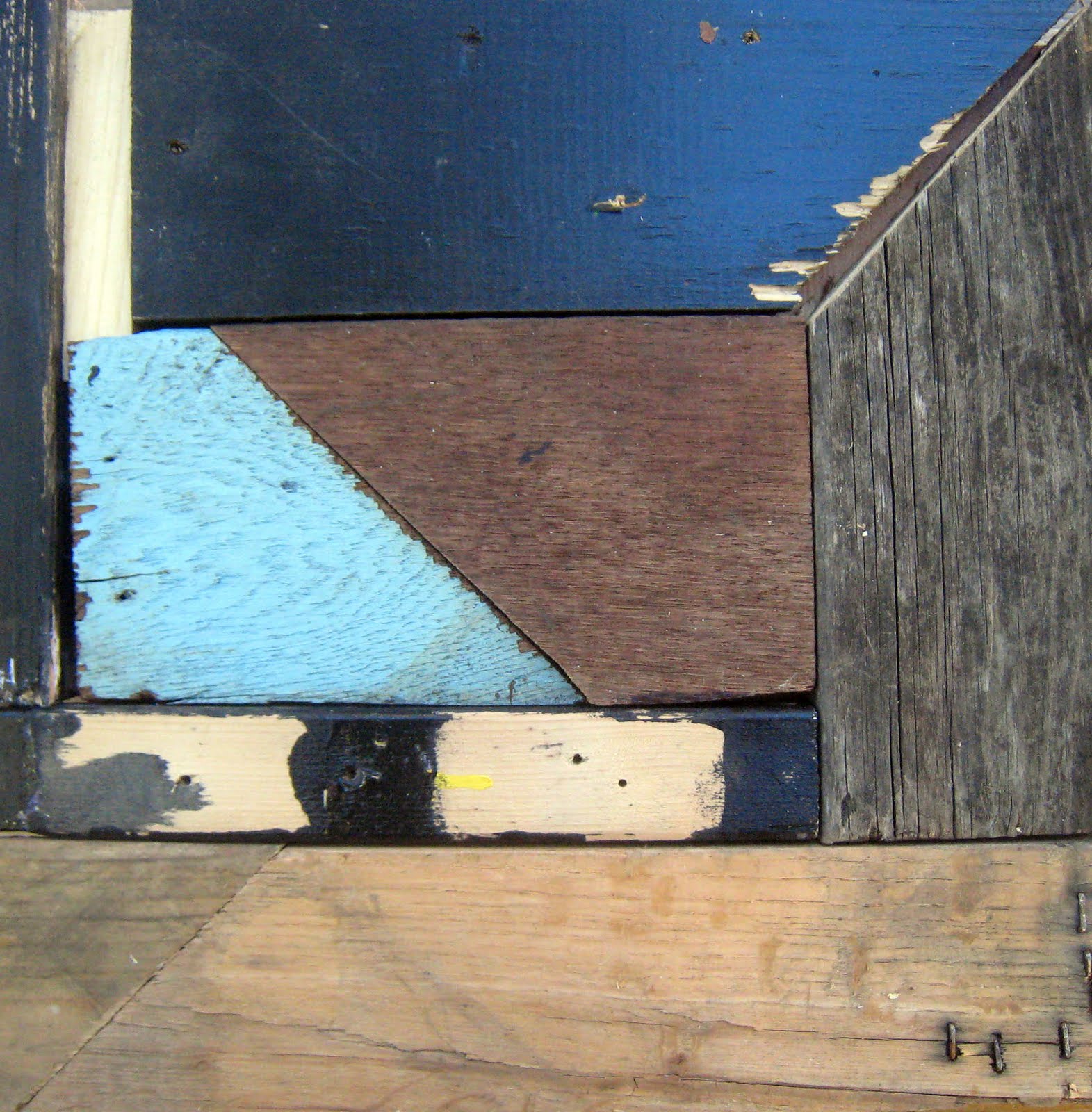
When I finished and was gathering up the corner bits and pieces from all the 45 degree miter cuts that had to make for the frames I became intrigued by how they could be fit together into these interesting shapes. Ordinarily I would have (reluctantly) disposed of the pieces but as I played with them I began form them into squares. Why squares? Who knows? That’s just how they seemed to fit. Obviously I could have gone in any direction but the squares worked for me. I used old and in some cases well worn pieces of wood so the execution on my part was a bit crude. Still, I enjoyed how each piece brought out a rustic variety of colors and textures.

For now I keep them stacked in a box. Maybe one day if I find an empty wall, I'll hang them up.