Thursday, February 3, 2011

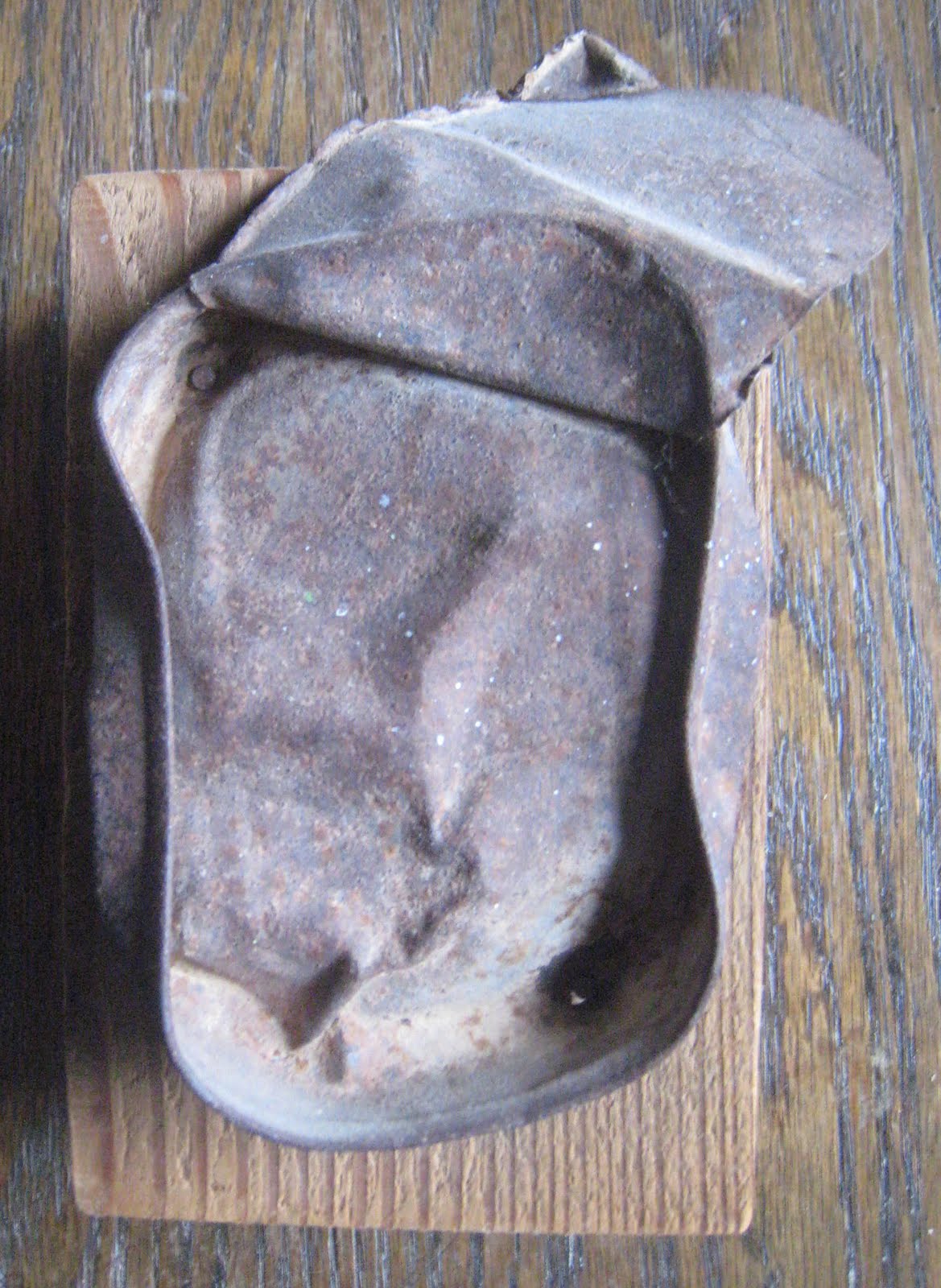
Cubism is a Crushed Tin Can


Once again I am revisiting a period of my life from over 30 years ago. As a soldier in the Israeli army we found ourselves on constant occasions in the desert in the midst of maneuvers. Much to my dismay and despair tons of garbage and spent debris would be abandoned and discarded as we moved from one spot to another. Sometimes we’d encounter piles that looked like ancient heaps of rubble, rusted and unrecognizable . Who know how long they had been sitting there? Someone once found an old hand grenade, probably from WWII.

I, on the other hand, set my sites on more mundane objects. An admirer of Marcel Duchamp, the father of found art, I was fascinated with the old rusted K-ration cans that littered the fields probably dating back to years of soldiers eating on the move. To others they were nothing more than disintegrating garbage but to me they were absolutely beautiful. I would collect them whenever I could, stuffing them into my ammunition belts, packs every open pocket I could find. Rattling cans make a lot of noise. So much for moving in stealth and maintaining an element of surprise.

You can still see the sands of the Negev and Sinai in the can crevices.

Monday, January 31, 2011

Everybody Let’s Twist


I was invited to decorate a plastic megaphone for a fund raiser. I could have taken the traditional route by painted it but after studying it a bit I realized that I was more interested a less conventional solution. Being the inveterate scavenger and collector of odds and ends that I am an idea began to emerge. I love music. I love dance. I would transform my megaphone into…….a ‘hula gogo dancer.’

I inverted an old mop and stuck the handle into a 10” section of railroad timber. This was the infrastructure for the dancer. The mop became a beehive hairdo, a former lampshade ring was used to create a hula skirt made of strings of marker tops. Her arms were made from wooden laths attached to a dowel that I passed through a hole in the mop handle and held everything together. Her hands were cut out of plastic milk jugs.

With a little paint and a sense of humor, my megaphone was transformed into a dancing queen.

Tuesday, January 18, 2011

Weaves


These are extensions of the Checkers series of made from cutting pen and ink drawings that were cut into strips and woven back together again. In these pieces I used remnants that I glued together to form strips and then them wove into 8"x8" squares. I then drew features with pen and ink and randomly assigned them to the woven squares. I enjoy the texture of the weaves contrasted with the features and how the portraits then emerges from the arrange of the features

Tuesday, January 11, 2011

Checker Portaits


On numerous occasions as a teaching artist in public schools I have given all kinds of demonstrations ranging from doing simple perspective exercises to building simple sculptures. In this case I was doing water color exercise illustrating some effects that could be achieved with water colors, not that I am anything close to an expert. But I can do some rudimentary exercises that are accessible to inexperienced students. At the end of the exercises rather than throw away the samples that I had used, I would keep them. After all it was decent paper and seemed a pity to throw it away just because it had some water color on it. After all, you never knew when it might in handy for something.

Well, I found a way for them to come in handy. When all else fails, weave them.

I ended up applying a white wash of acrylic paint over the water color designs to create a neutral field, allowing for the water color to bleed into the whitepaint. I then used a thinned down black paint and a bit of ink to draw very simple but similar portraits on twelve small squares of the used water color paper squares that I had used as samples with the kids. I then cut pairs of drawings into strips and wove them back together, as I have done on countless of other occasions. The results, though not new, are always a surprise. I’m calling this series ‘Checker Portraits.’


Friday, December 31, 2010

Bulletin Board


What is a bulletin board? A collection of flotsam and jetsam. A visual cacophony. An assemblage of miscellaneous things that are tacked to cork panels. Pictures that trigger tactile memories. Details that inspire creativity. Random impressions layered one over the other.

These bulletin boards have been secured to the low narrow wall of my studio above the old pegged frame that use for my easel for 20 years. I look at them every single day and only now have realized that I have never given them their due. They include pictures that I enjoy, sentimental bits and pieces, photos from past, and other things that just plain inspire me.

The best part is that there is always room for more.

Monday, December 13, 2010

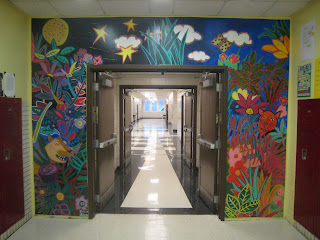
The Goudy Murals


As a teaching artist in public schools in Chicago I initiate any number of art oriented programs. At Goudy School I was hired to paint a mural over an entry way on the 2nd floor. But within moments of my introduction to my team of 7th and 8th students I was certain we could create an additional mural on the third floor as well.

As a group we decided that the theme of the first mural would be the Cougar, the school mascot. The students prepared simple pencil sketches of cougars that I cut out and collaged to create the ‘working drawing’ on which the mural would be based. We then prepared four plywood panels onto which we transferred the images from the working drawing and shortly after that began to paint. We completed the mural in about 5 sessions.

The mural is called ‘Cougar Pride’, an imaginative, colorful and vibrant collection of cougars that reflect the interesting and widely (and wildly) diverse community of students that attend Goudy.

The second mural is called ‘The Goudy Garden’. It was also created from a collage of sketches. In this case the subject was flora and fauna and a reference to the actual garden in the yard outside of Goudy School.

The result is a dense jungle cacophony of color, shapes and design. The image represents yet another way to see Goudy School, as a thriving community that nurtures and enables its students to blossom and flourish.

But neither of these two murals would have been successful without adhering to the Six C’s .

Cooperation. As a diverse group of kids we needed to be able to work together, to cooperate, as a team.

Collaboration. The students needed not only to collaborate and to work as a group but also as individuals that treat one another with consideration.

Communication. It was essential that the students shared ideas with each other and listened respectfully.

Commitment. The murals would not have been successful if the students were not motivated or if they were not reliable.

Creativity. Without being able to use their imaginations, to problem solve and discover new ideas, the murals that we now see would be only a dream.

Cougars. First and foremost, we are Cougars, and represent the very best in ourselves, our school, and our community.

Goudy School is a very special school. 29 languages are spoken within its walls. Within my program alone there were students whose families came from Nigeria, Nepal, Pakistan, Vietnam, and China. The murals are beautiful pieces of art. But they also reaffirm in a most positive way just how rich and lucky the community is to enjoy such a range of boundless energy and creative diversity within its midst.